Gordon Conner Studio
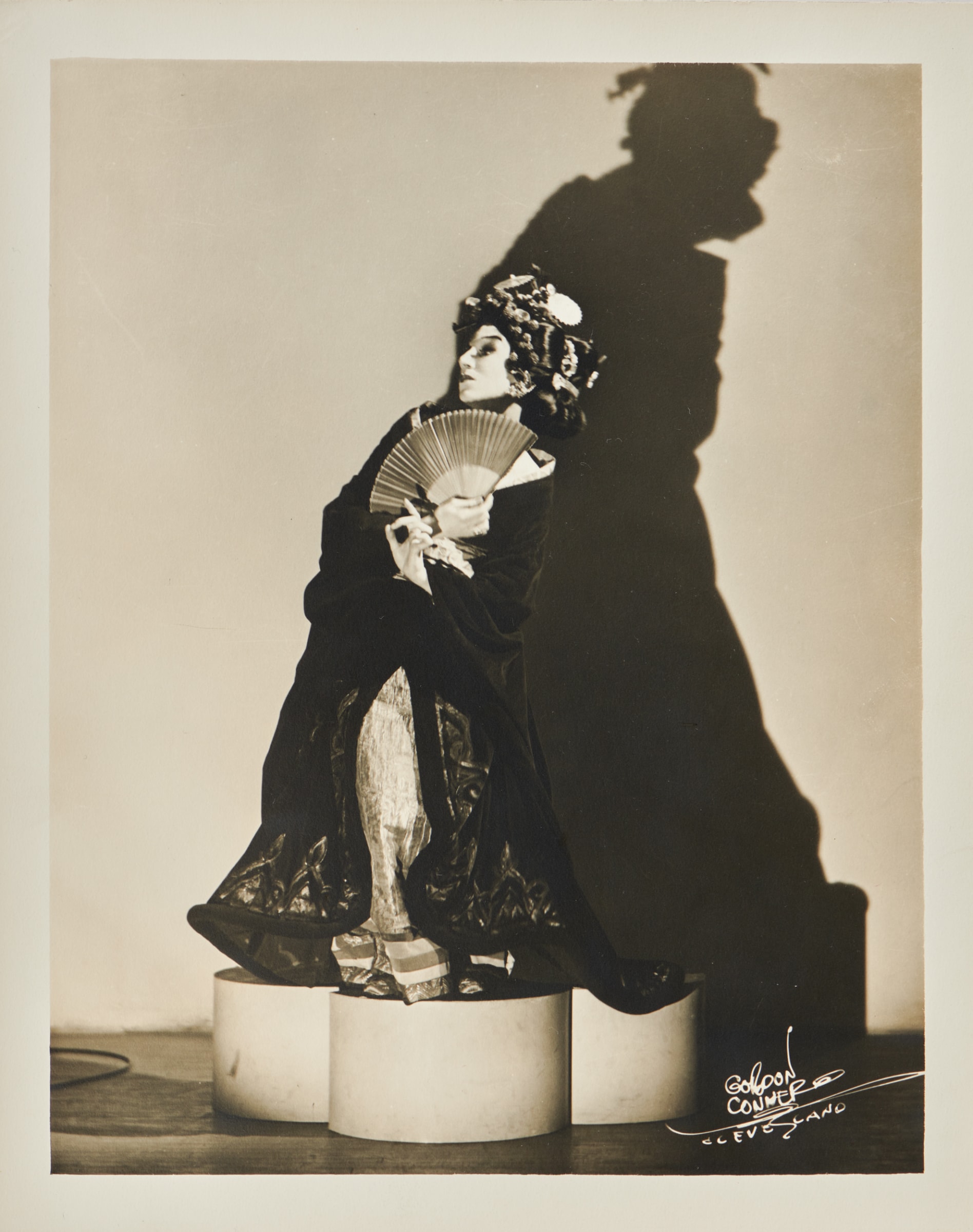
Evocative portrait of Li-Kar, longtime star at pioneering San Francisco gay club Finocchio’s, c. 1940
Silver print
8 x 10 inches
Sold
Evocative portrait of Li-Kar, longtime star at pioneering San Francisco gay club Finocchio’s. The term “drag queen” didn’t exist in the late 1930s and early 1940s. Newspaper listings would sometimes...
Evocative portrait of Li-Kar, longtime star at pioneering San Francisco gay club Finocchio’s.
The term “drag queen” didn’t exist in the late 1930s and early 1940s. Newspaper listings would sometimes promote “female impersonators,” but more often, venues specializing in such performances described themselves only as “unique” or “novel” or “the oddest nightclub in town.” These establishments were not explicitly marketed to nor did they exclusively serve LGBTQ patrons, but they were spaces where diverse understandings of gender and sexuality were welcome and expected, decades before the gay liberation movement began.
One exemplar was Finocchio’s Club, located in San Francisco’s North Beach neighborhood, established in 1937 by Italian immigrant Joe Finocchio. (That “finocchio” is also a traditionally derogatory Italian slang term for gay men is just a rather incredible coincidence.) Finocchio’s was a 1940s celebrity hotspot and a tourist draw until its closure in 1999. For decades, Li-Kar played many creative roles for the club, including drawing caricatures for programs, painting murals, and designing gowns, for which he won considerable renown both in and out of the drag community -- Tallulah Bankhead was one famous client.
Li-Kar was also an onstage performer at Finocchio’s during its Swing Age heyday. In 1941, an around-town column in the San Francisco Examiner reported on someone declaring “that Li-Kar is prettier than any Earl Carroll girl,” referring to the Broadway impresario famous for his showgirl-themed productions. And the speaker should have known considering it was apparently Earl Carroll himself. As a performer Li-Kar, who was born Lee Carr in Chicago, specialized in Asian-themed characters that would not be considered appropriate today. But in the context of its time, it was just another element of the sense that at Finocchio’s, no one had to be who they were assumed to be at birth.
This photo is a potent reminder that all of history contains LGBTQ history, even when it was far less documented than it deserved to be. Overall a rare and important artifact with immensely compelling, film noir-evoking visual appeal to boot.
The term “drag queen” didn’t exist in the late 1930s and early 1940s. Newspaper listings would sometimes promote “female impersonators,” but more often, venues specializing in such performances described themselves only as “unique” or “novel” or “the oddest nightclub in town.” These establishments were not explicitly marketed to nor did they exclusively serve LGBTQ patrons, but they were spaces where diverse understandings of gender and sexuality were welcome and expected, decades before the gay liberation movement began.
One exemplar was Finocchio’s Club, located in San Francisco’s North Beach neighborhood, established in 1937 by Italian immigrant Joe Finocchio. (That “finocchio” is also a traditionally derogatory Italian slang term for gay men is just a rather incredible coincidence.) Finocchio’s was a 1940s celebrity hotspot and a tourist draw until its closure in 1999. For decades, Li-Kar played many creative roles for the club, including drawing caricatures for programs, painting murals, and designing gowns, for which he won considerable renown both in and out of the drag community -- Tallulah Bankhead was one famous client.
Li-Kar was also an onstage performer at Finocchio’s during its Swing Age heyday. In 1941, an around-town column in the San Francisco Examiner reported on someone declaring “that Li-Kar is prettier than any Earl Carroll girl,” referring to the Broadway impresario famous for his showgirl-themed productions. And the speaker should have known considering it was apparently Earl Carroll himself. As a performer Li-Kar, who was born Lee Carr in Chicago, specialized in Asian-themed characters that would not be considered appropriate today. But in the context of its time, it was just another element of the sense that at Finocchio’s, no one had to be who they were assumed to be at birth.
This photo is a potent reminder that all of history contains LGBTQ history, even when it was far less documented than it deserved to be. Overall a rare and important artifact with immensely compelling, film noir-evoking visual appeal to boot.